

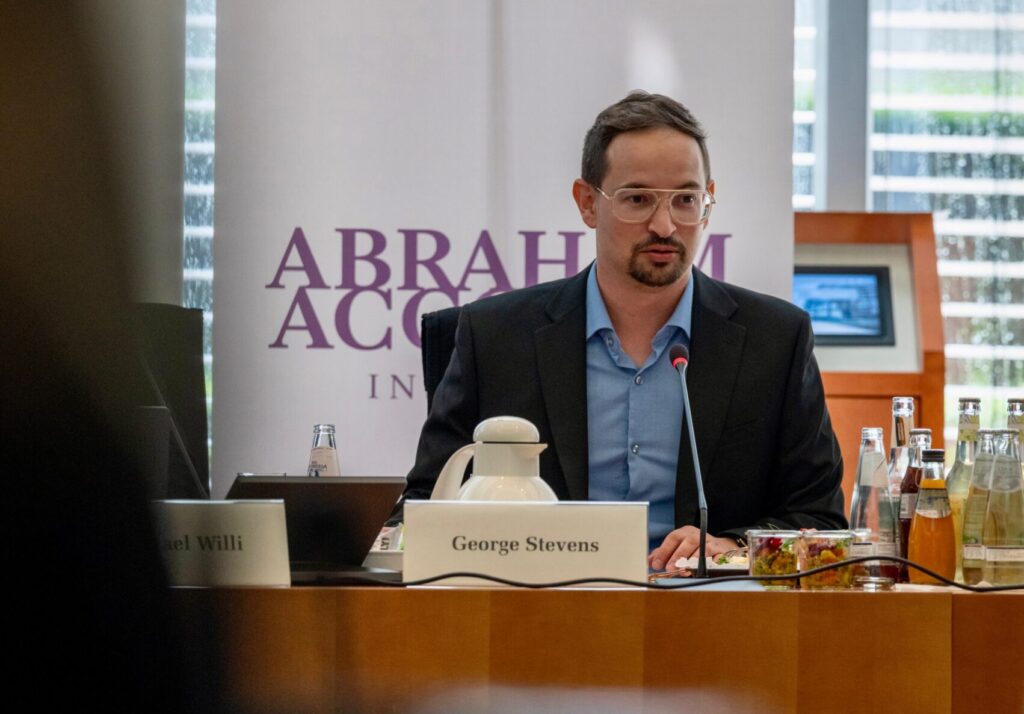
Thank you so much to Nathanael and Abraham Accords Institute team for hosting us.
Thanks to His Excellency the Ambassador and all the diplomats here.
It’s a great pleasure and a great privilege to be here.
And I also want to start by acknowledging a little bit of my own history and why there is an Israeli Jew sitting in front of me named George Stevens, which is the least Israeli and these Jewish names possible – besides Christian Christians or something like that.
My grandfather is the one on the picture on the left.
This is him when he was 13, a little after the Nazi’s kinder power.
His name was Georg Hein, and I’m named after him.
And that’s his mother, Henni Hein, on the other side.
When my grandfather was 14, a year after his rise to power, he escaped to England with his older brother, and he survived.
His mother, Enyihan, did not. She died in the Holocaust.
The day the war broke out, they started sending German Jewish men to Canada from England to isolate them from the population.
They were worried they would spy for Germany and he didn’t want to do that, so he stole the name of a classmate of his who had died, named Peter Stevens.
He stole the name and became a Royal Air Force bomber pilot.
He bombed Berlin, he bombed Hanover where half of his family was still living.
And he has a very unique story in the war. He became a prisoner of war, organized an escape attempt, he spoke fluent German so he could forge documents and everything.
And he never told us he was Jewish.
He died, and no one knew this part of the story. My dad never knew this.
Coincidentally, he married a Jewish woman, converted to Judaism, without knowing this.
And then we discovered this in the 90s.
And this (in the picture) is me and my father at the Stolperstein Memorial installation.
To speak at the Bundestag, I wanted to give you a little bit of background about family story and the emotional meaning of being here today.
So moving from the personal to the professional, the organizational, I’ll tell you a little bit about WeAreMENA.
WeAreMENA is a network of moderate institutions and organizations that deal with youth from around the Middle East, from the Levant, the Gulf area, North Africa. Our 18 organizations comes from Syrian and Kurdish backgrounds, Cypriots – both Greek and Turkish, Tunisians, Moroccans, as Fajanis has said a little bit, and a few Israelis, and I’m probably forgetting a few right now.
We have Shia and Sunni members, and Druze and Christians and Jews.
And we see the core issue of our region is conflict, and the core issue underlying conflicts is dehumanization – that we don’t fully understand each other and see each other as full and deeply rich human beings.
And our mission is to rehumanize one another, to understand we don’t need to necessarily agree with each other on everything or even love each other on everything.
But if we can understand that the youth from different religions and different backgrounds and different nationalities, that they have hopes and dreams and culture and struggles.
And if we can understand those hopes and dreams and struggles in their culture and their world – and again, I’m not trying to be a naive utopian optimist – but then we can humanize one another and we can move forward and be productive in our relationship with one another.
And we try and do impact-driven encounters, not just talking, but doing.
We presented at the Global Climate Conference.
This is a picture of last year’s Journey from Hate to Hope program on the day that we visited Auschwitz.
And why do we focus on youth?
So I want to bring up a very German Jewish philosopher, Martin Buber.
As World War I was coming to an end – at that point over 10 million people died, the largest conflict in the history of the world – he gave a speech, an optimistic speech, even though Germany was being destroyed, Europe was being destroyed. He gave an optimistic speech and he said, youth, even in the worst hours of the worst destruction possible, youth are the eternal possibility for humanity’s happiness.
And if we embrace the youth and if we utilize their power and their optimism and their will for good in the world, we can build a better reality no matter how much our country or our community is destroyed.
And for me, that’s a powerful message, especially coming from the Middle East at this time, which has seen so many conflicts over many, many years, especially in the last few years – that even in the worst times, youth still represents a huge opportunity for a better future.
So there’s many levels to diplomacy and relations between peoples and nations.
There’s statecraft.
There’s security, there’s economic ties.
We see all of those as essential.
We focus on the human side.
We focus on people and education and youth and connection.
And one of our biggest inspirations is actually the German-French relationship and the European Union. Specifically Germany and France fought in the Napoleonic Wars and Bismarck’s wars and World War I and again World War II.
And finally after World War II they said enough is enough.
They united their coal and steel industries and they made sure that they could never go to war again because the coal and steel industries which you need to make guns and tanks and everything were united.
A decade after that they created the Franco-German Youth Office to make sure that the youth whose parents had literally been shooting at one another could understand one another and have positive experiences with one another.
Fast forward half a century and the European Union set up the Erasmus+ program, which connected over 10 million youth and young adults from around Europe and even across the Mediterranean and different parts of the world.
And we see that as a huge inspiration for us, but we don’t want to do exactly the exact same thing – because we’re Middle Eastern and we’re North African and we’re slightly different than Europe.
For instance, our vision statement – which is in the folders around you – opens with quotes from the Quran and the Hebrew Bible and the New Testament.
And I think if a European version of WeAreMENA existed – they probably wouldn’t open the vision statement with quotes from these three religions. But that’s who we are.
And in our region, the role of religion is inseparable from public life.
And so that’s what I’m gonna tell you.
How do we do this through something like what happens in Europe, but not in a European way or an American way, but in a way that’s true to ourselves?
How do we find true partners who believe in this vision and who know how to work to transform it into reality?
How do we maintain relevance for youth in a world that’s changing rapidly, in a region that’s changing very, very rapidly and has many, many conflicts?
How do we stay…
And we realized have been no serious studies on this issue, at least none that have covered all the nations of our region.
And we turned to a good friend, Einat Levi, who’s wonderfully experienced, and her team of very serious researchers. And we decided to look at this issue more in depth, how can we understand the youth of our region, youth diplomacy, youth organizations, etc., in our region – and to do a serious research project. We spent half a year working on it, and here it is.