
Acceptance Remarks
Recognition for Advancing Civil Society Connections in the Middle East
Tom Vizel | Founder and Executive Director, WeAreMENA
Dear President of the Ambassadors’ Club, Mr. Itzhak Eldan, distinguished ambassadors, the Israel-Morocco Chamber of Commerce and Industry, ViaCity, the Abraham Accords partners, friends, and fellow honorees,Thank you for this recognition and for bringing us together this evening.
I want to take you back to one evening: October 6th, 2023.
At the time, I felt like I was riding a wave.
It was three years after the signing of the Abraham Accords, and with a small and very committed team, I was building a regional network of youth organizations across the Middle East and North Africa.
Things were happening.
An event in Morocco. A youth delegation to the Emirates around sport. A meeting with the Bahraini Minister of Youth. An invitation to a peace-related event in Saudi Arabia.
One opportunity seemed to lead to another. And it felt like we were adding our own small brick to something much bigger that was happening in the region.
We all know what happened the next morning.
October 7th changed everything.
The massacre, the war, the grief and fear that followed shook all of us. And very quickly, the dehumanization on all sides became almost impossible to escape.
My own life changed too. I was called to resevere service for monthes and became a father. Programs we had spent months building were cancelled. I had to let go of team members I had only recently recruited, and I found myself looking for other work.
And I genuinely wondered whether everything we had been building had collapsed.
Then people started reaching out.
A friend from Syria called just to ask how I was.
A colleague from Jordan sent me a message of care and concern.
A partner from Gaza, who had managed to leave a year earlier, reminded me that even in the darkest circumstances, there are people who refuse to give up their humanity.
Those conversations stayed with me.
And gradually I understood that what we had been building had not become less important after October 7th.
It had become more important than ever.
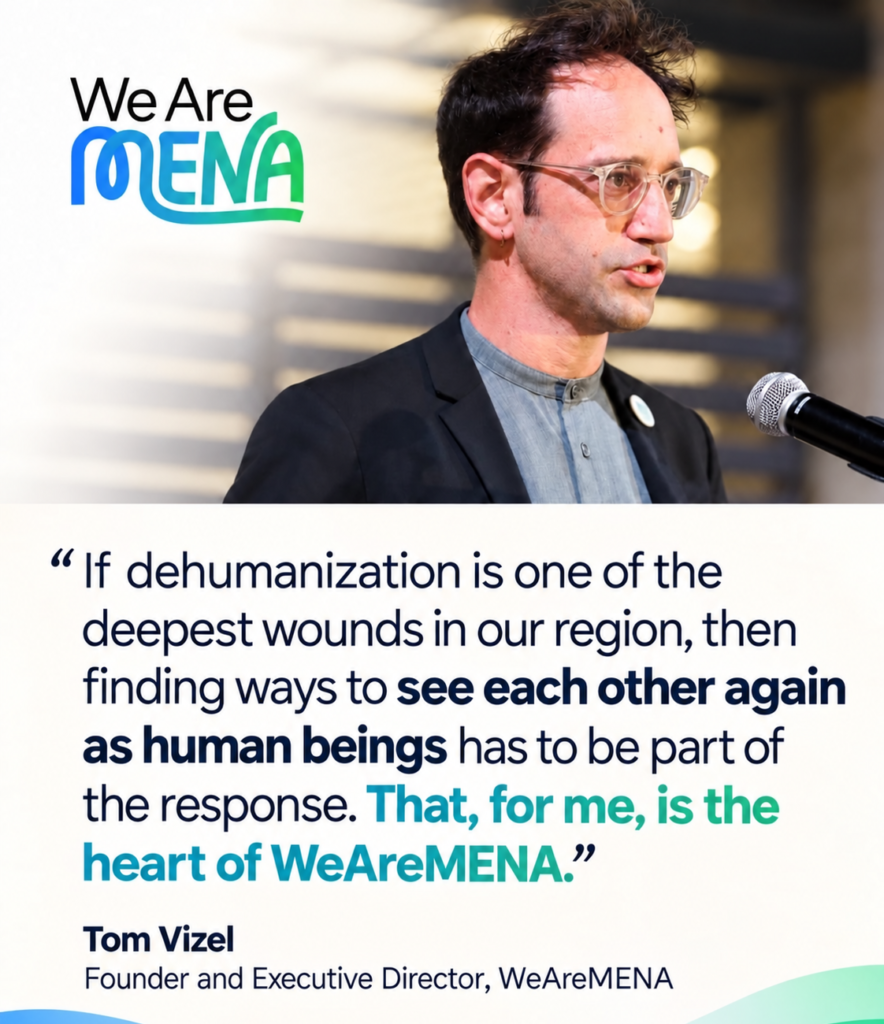
Because if dehumanization is one of the deepest wounds in our region, then finding ways to see each other again as human beings has to be part of the response.
That, for me, is the heart of WeAreMENA.
Today, WeAreMENA brings together more than 20 youth organizations and civic partners across more than 10 countries across the Middle East and North Africa.
Some are in countries that have peace agreements with Israel. Others are in places where there are no diplomatic relations at all, and where simply being part of this kind of network requires enormous trust — and sometimes discretion (dis-cre-tion).
Over time, we also understood something important about the way we wanted to work.
It wasn’t enough to bring individuals together.
A meeting can have an enormous impact on one person. But when you work through organizations, that person can take the experience home.
Youth organizations know their own communities. They know the language, the culture, the sensitivities and the fears. They work with young people, educators and families whom I, as an Israeli, may never be able to reach directly.
And that is how a relationship between a few people can begin to reach much further.
Step by step, the leadership of our member organizations is shaping a shared network and pedagogical framework for regional civic action. Within this framework, the organizations themselves are developing programs like Israeli-Palestinian re-humanization seminar, minority encounters in the Middle East, and Holocaust education trainings in North Africa, which have already reached nearly 100 Arab and Muslim teachers.
These numbers are still modest. We are still building.
But I believe very strongly in what sits behind them.
Sustainable peace cannot depend only on governments, security arrangements or economic agreements. All of those things are essential. But ultimately, people have to be able to live inside the agreements their governments make.
That requires educators willing to teach complexity. Young leaders willing to meet people they have been taught to fear. Organizations rooted in their communities. Cities, religious leaders, women and young people creating connections that regional diplomacy alone cannot create.
We are not trying to replace traditional diplomacy.
We are trying to build alongside it.
And I know that right now, talking about regional integration, the Abraham Accords, or projects like IMEC can sometimes feel disconnected from the reality around us.
Sometimes it can feel like a dream. But the fact that something feels distant does not make the work meaningless. If anything, this is precisely when the relationships we build matter most.
There are young women and men in our network who come from places where even speaking with someone like me can create suspicion — and sometimes real risk.
And still, they show up. Sometimes openly. Sometimes quietly.
They meet. They listen. They disagree. They learn about each other. And they keep the relationship going, even when everything happening around them gives them a reason not to.
I think that takes courage.
So I accept this recognition tonight with gratitude, and on behalf of the many young leaders and civil society builders across the Middle East and North Africa who deserve to be seen, supported, and recognized.
Because the future of this region will not be built by governments alone.
It will also be built by educators, cities, communities, Women and Man who are willing to keep talking, keep meeting, and keep seeing the human being on the other side.
Thank you.
